
Emotion Coaching at Every Age: What It Looks Like, Why It Matters, and What to Do When Your Teen Stops Letting You In
The parenting lessons we learn in the baby and toddler years don't expire. I think of them as the foundation, and we keep building on it all the way through childhood. They just wear a different hat at every age.
Emotion coaching might be the clearest example. In my work, I think of it as starting the day your baby is born, and it doesn't stop at toddlerhood, even though that's where most of the advice stops. It's also the one nobody prepares you for at the far end: the teen years, when the big feelings may stop coming to you.
If you read last week's article about emotional validation, you know the five steps (Gottman & DeClaire, 1997): notice the emotion early, connect instead of correcting, validate it, name it, then hold the boundary while you solve the problem together. Those steps are the same at every age. What changes is what they look like, how much your kid can do alone, and how much of your job is staying close versus stepping back. This piece is the map from baby to teenager. If you want the exact scripts for each step, start there.
What your child is actually building
Before the ages, the why. If I'm asking you to keep doing something for sixteen years, you should know what it's for.
Emotion coaching isn't about ending meltdowns. It's slow work on three things. The first is the ability to feel a big feeling without being run by it. The second is coming back from it faster. In one of the first studies to follow this idea over time, Gottman and colleagues tracked 56 families from the time the kids were about 5 until they were about 8. Kids whose parents coached their emotions tended to have better physiological regulation, better peer relationships according to their teachers, and higher school achievement (Gottman et al., 1996). It was a small, correlational study, so it can't prove that coaching caused those differences. Later trials of parent programs built on emotion coaching (Tuning in to Kids and Tuning in to Teens) tested the idea more directly and found improvements in parents' emotion coaching. The teen version also reduced family conflict and youth behavior problems (Havighurst et al., 2010; Havighurst et al., 2015; Kehoe et al., 2014).
The third is the one people miss. I think of it as your voice becoming their voice. What you say at three ("you're so mad, and I won't let you hit") is what I hope they eventually say to themselves at thirteen, and at 30.
What emotion coaching doesn't do is fix tonight. Every meltdown you coach through is a rep, not a result, and the payoff shows up years later, usually when you're not looking.
In my experience, each stage also builds on the one before. Language has to show up before a toddler can label feelings. Practice noticing helps a school-age kid find a feeling in their body. A teen needs to have learned that a big wave is survivable before they can ride one out. If a stage got skipped in your house (in most houses, something did), you can go back and start there at any age. That's not failure. It's the next step.
Infancy (birth to about 12 months): be the nervous system they don't have yet

A baby's feelings are really needs, and they can't regulate any of it on their own. They borrow your calm because theirs isn't built yet. That's emotion coaching at this age: attunement.
What it looks like. Your baby rubs their eyes, turns away, starts to fuss. You catch it before the full cry: "You're tired. I know. Let's get you down." Soft voice, slow movements. When you guess wrong (not hungry, not wet), you try the next thing and stay calm while you do it.
Why it matters. In attachment terms, this is the root of what comes later: the sense that big feelings can be handled and that people help.
While you're learning. You'll misread them constantly. Ed Tronick, who studies mother-infant interaction, found that even healthy pairs are in step only part of the time, and his model says what matters most is the repair that follows a miss (Tronick, 1989). That's good news.
When it's working. Your baby settles faster when you pick them up, and eventually seeks you out when they're upset.
How long. Babies can't regulate themselves for a long time, so this stage is mostly borrowed calm. It's also why your own rest matters more than any technique.
Toddlers and preschoolers (1 to 5): name it, welcome it, hold the line

Now there's language, a very strong will, and, for many kids, hitting. Big feelings, tiny brakes.
Naming it. "You're frustrated we have to leave." In lab studies with adults, putting a feeling into words has been linked to quieter activity in the brain's threat-detection areas (Lieberman et al., 2007; Torre & Lieberman, 2018). Later studies have had mixed results, and no one has tested whether a parent naming a child's feeling does the same thing. In my practice, naming works best as an offer ("you seem frustrated?") that lets your kid correct you.
It also doesn't always go the way the books say. The first time I tried it with my son, mid-meltdown, I said, "I see you're mad." He stopped crying, said "I'm not mad," got up, and moved his tantrum across the room. I wrote about why that happens, and the full five-step process, in last week's article.
Holding the boundary when your kid is losing it. This is the part almost nobody teaches, so let's walk through it.
Your four-year-old is melting down because you turned off the show. They swing and hit you.
First, stop the behavior with your body and very few words. Catch the hand gently and say one short sentence in a low, calm voice: "I won't let you hit." Then name it: "You're so mad." Keep it short. When kids are this upset, long explanations rarely land.
Second, make space without leaving them. "I'm going to move over here so nobody gets hurt. I'm not going anywhere." Stay within sight and earshot.
Now the question everyone asks: what if they hit again? They probably will. The first hit is the feeling. The second is often a test: is this limit real? The pull is to get louder, add threats, or give in to make it stop. Do none of those. Say the same short sentence, in the same calm voice, and take the same action. Be boring.
Gerald Patterson's work on what he called coercive cycles found that when a child's escalation gets the parent to cave or explode, the escalation tends to get stronger (Patterson, 1982). The influence runs both ways, since kids shape parents too. When the parent stays calm and consistent, the pattern tends to fade. In my experience, it often gets worse before it gets better, and that usually means the new response is registering.
What if they hit a sibling or a friend instead? Go to the hurt kid first, briefly: "Are you okay? I've got you." Hitting should get less attention than being hurt. Then go back to the kid who hit, calm: "I won't let you hit. You're furious. Hitting hurts. You can stomp, squeeze this pillow, or yell into the couch." Giving the feeling somewhere to go is the point. The feeling is allowed. The hands are not. At a playdate, leave calmly and save the lecture, or skip it entirely.
Later, when everyone's calm, repair. Ask what they could do for their sibling and let them choose (a drawing, checking in on them) instead of forcing a scripted sorry. Then practice when nothing's happening: "Next time you're that mad, what could your hands do instead?" Kids learn this in calm moments, not in the middle of a storm.
And if you're the one about to lose it, take thirty seconds. Make sure your kid is safe, breathe out slowly, and come back. It's hard to hold a boundary from a nervous system that's already in a fight.
Physical aggression is common in toddlerhood. In a large study of more than 2,000 young children, it rose through the second year of life and declined from the third birthday on (Alink et al., 2006). In a study that followed about 500 kids from 17 to 42 months, about 14% stayed on a high, rising path (Tremblay et al., 2004). If hitting is frequent, intense, or not easing as your child gets older, mention it to your pediatrician.
While they're learning. They'll hit again. They'll say "I'm not mad." They'll fall apart over the same thing for the fiftieth time. That's the rep.
When it's clicking. Words start replacing hands ("I'm MAD!"). They pause a beat before swinging. They come looking for a hug when the storm passes, or they narrate feelings in pretend play ("the bear is sad").
How long. Months to years, with real change usually showing up across the preschool years. It depends on language and on those early brakes, which build slowly.
School age (about 5 to 11): feel it in the body, read it in others, fix it in real time
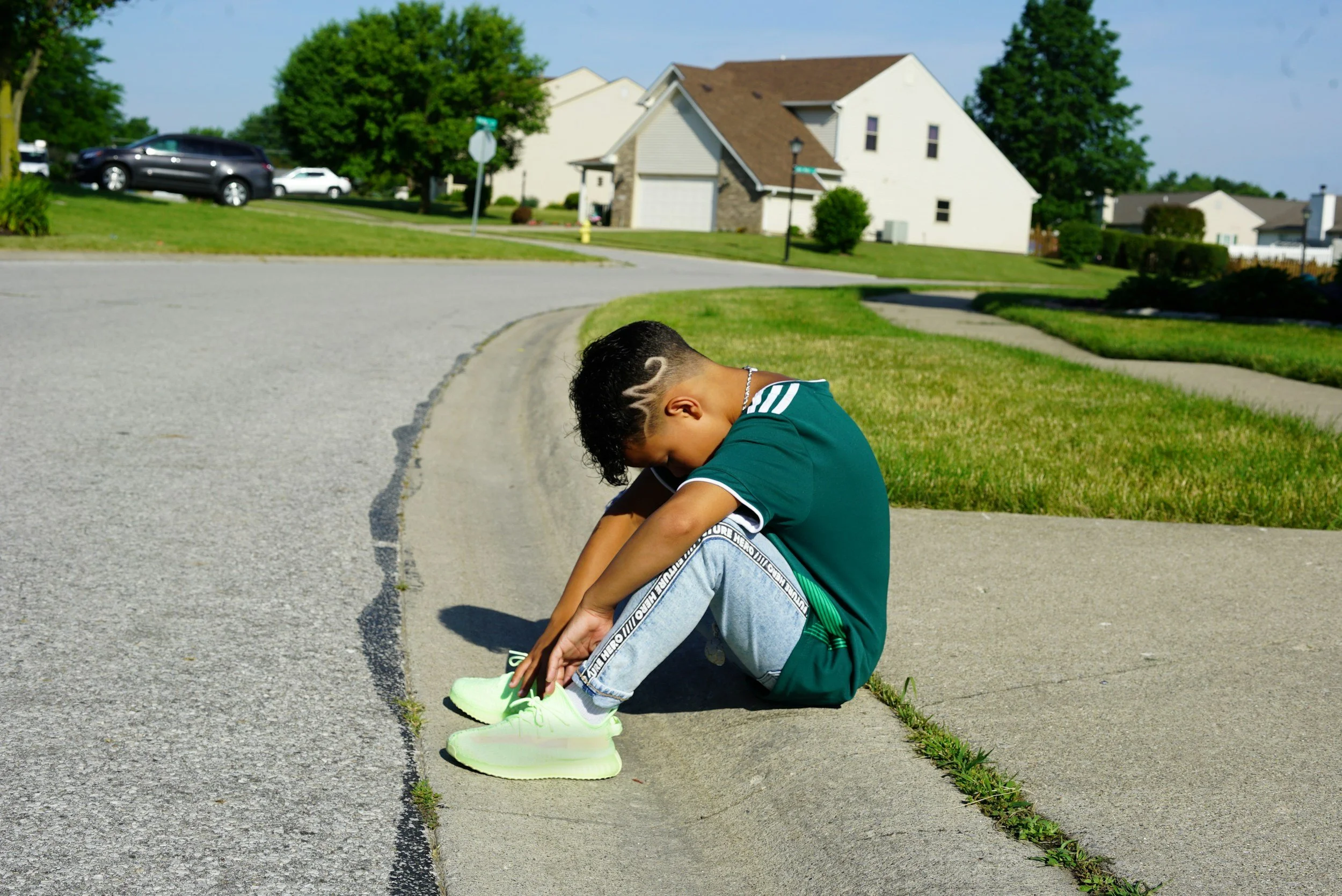
Now they have the words, so the work shifts. Notice what a feeling does in your body before it takes over. Do something about it before the blowup. Start reading other people. And problem-solve once things settle. The examples below are practice guidance, not research findings.
What it looks like. Your kid comes home from school and falls apart over a snack. Instead of "you were fine all day," try: "Rough day. Where's it sitting in your body?" (tight chest, hot face, stomach flip). Teach them to rate it: "Is it a 3 or an 8?" At a 3, a drink of water and a break can do it. At an 8, nothing works yet, so we wait, and the problem-solving happens later. Researchers call the thinking we do in emotionally charged moments "hot" executive function, and it works differently from the calmer kind (Zelazo & Carlson, 2012). That's one reason you can't think your way out at an 8.
Coach them on other people too: "Did you see her face when you said that? What do you think she felt?" Kids this age are learning to be good friends, and it starts with noticing.
Why it matters. By about age 8, the kids in Gottman's study whose parents coached emotions tended to show the differences described above (Gottman et al., 1996). This is the stage where the skill starts to move from you to them.
Holding the boundary at this age. Your eight-year-old slams the door, screams "I hate you," or hits their brother. Don't match the volume. "You can be furious. You can't hurt your brother. Take five minutes in your room, and I'll come get you when your body's calmer." If they escalate, say the same sentence again, and don't argue the content of "I hate you" in the moment. If they hit again, same calm response, same consequence, no new threats. After they've settled, repair and problem-solve: "What happened right before? What could you try next time?" Keep consequences small, calm, and connected to what happened (the thrown toy gets put away for the day).
If the same blowup happens every day at the same time, look at the pattern before you look at the kid. Hunger, a long day, a tough transition: it's often data, not defiance.
While they're learning. They can tell you what they felt after the blowup, not during. "I don't know" is often an honest answer.
When it's clicking. "I need a minute." They use a strategy on their own, at least some of the time. They come back to repair without being dragged.
How long. Years. This stage covers most of elementary school.
The teen years: regulation, plus the skill nobody talks about

Here's why teens can feel like a different species. Researchers use a simple picture of what's happening: an emotional and reward system that revs up early in puberty, with the brain's braking system still developing (Steinberg, 2005). It's useful shorthand, not a settled map. Scientists still argue about the details, including how long the brakes keep developing (Pfeifer & Allen, 2012). In my experience, the practical point holds either way: teens feel big, and self-control under emotional pressure is still a work in progress.
There are two jobs at this stage, not one.
Job one is regulation: turning the intensity down. Validating still matters here, even with a sixteen-year-old. "That sounds really painful" does real work.
Job two is distress tolerance: staying with a feeling that isn't ready to turn down, without escaping it, numbing it, or blowing it up. Some feelings can't be turned down on demand: heartbreak, humiliation, being left out, grief. A teen who only has regulation tools hits a wall when those don't work, and then reaches for escape: endless scrolling, storming off, shutting down, snapping at everyone in range.
Most teens have been taught coping skills somewhere along the way, like breathing, grounding, taking a walk. Then something real happens and none of it shows up. In my experience, that isn't because they forgot. A skill learned in a calm room doesn't automatically work in a chaotic one. They need reps, and they need someone to help them use the skill in the moment it counts.
What DBT is. DBT stands for dialectical behavior therapy. Psychologist Marsha Linehan developed it to help people in intense emotional pain (Linehan, 2015). It has since been adapted for teens (Rathus & Miller, 2015), with parents in the room through a multifamily skills group, so everyone at home learns the same skills. It's built around holding two things together: accepting how things are and working to change them. Distress tolerance is one of its core skill sets. One caution: most DBT research is with teens facing serious struggles. What follows are everyday-sized versions of the skills.
Riding the wave. Often called urge surfing, it comes from addiction researcher Alan Marlatt's relapse-prevention work and is widely taught in DBT-style programs. The idea is to notice the feeling in your body, name it, and watch it rise and fall instead of fighting it. In one small study of college smokers, people taught the technique still felt the urges but smoked less over the next week (Bowen & Marlatt, 2009). The authors called the findings preliminary. They fit the idea that the skill changes what you do with a feeling, not whether you have it.
Settle the body first. A hard walk or workout, slow breathing with a long exhale, a hot shower, music, a comfort item. In my experience, a feeling is hard to think through when the body's at a nine.
Radical acceptance. "This happened. Fighting the fact that it happened keeps me stuck." It doesn't mean approving of it or liking it. It means putting down the argument with reality.
A delay I use (my adaptation of urge surfing). "I'll wait twenty minutes, then decide." A timer buys the wave time to pass.
What it looks like: Let’s say your teen just went through a breakup. Say your 16 yearold finds out their first love, the one they've been with for three months, has already moved on. New person, photos posted within the week.
The hit. Stomach drops, face goes hot, can't catch their breath. "How can they be fine?" On brain scans, rejection lights up some of the same regions involved in physical pain (Eisenberger et al., 2003), and a small study of people who'd just been dumped found reward and craving circuitry active when they looked at their ex's photo (Fisher et al., 2010).
The climb. They're on their phone, rewriting a text they'll never send, scrolling the new person's page, replaying everything. The thoughts get loud: "I'm so stupid. Nobody will ever love me. They never even loved me." The urges show up: text them at midnight, say something cruel, post a vague sad quote, skip school, snap at everyone.
The peak. Door closed, crying so hard they can't talk, or flat and silent. Either one is a peak. You'll hear "leave me alone" or "you don't understand."
The ease. Crying slows. They're wiped out, maybe hungry, maybe they laugh at something dumb. A few hours or a day later, a little room opens up.
The return. The next day in the hallway, or when a certain song plays, another wave, usually smaller. Here's the honest part: in a study of more than 200 high school students recalling recent emotional episodes, sadness lasted longest of 27 emotions, about five days on average. The longest-lasting emotions went hand in hand with event importance and rumination (Verduyn & Lavrijsen, 2015). So it's rarely one wave. It's a set. The skill isn't getting rid of the heartbreak. It's learning each wave passes.
What coaching sounds like, if they let you in.
At the hit and the climb, validate fully: "That is brutal. You loved them, and they moved on fast." Not: "You're sixteen, you'll find someone else." Then ride the wave out loud: "This is going to feel like the worst thing in the world for a while. It'll probably get bigger before it eases, and it will ease, even if that's impossible to believe tonight. You don't have to feel better tonight."
Ask about the urge: "What do you feel like doing right now?" If it's texting the ex: "Let's give it twenty minutes. Set a timer. If you still want to send it after, we'll look at it together." Offer a tool and let them choose: "Do you want to hand me your phone tonight, or put it across the room?"
At the peak, use fewer words. Sit nearby, bring water or food, and say, "I'm not going anywhere. No need to talk."
On the ease, that's when conversation happens. "What helped?" "What do you want me to do next time, and what do you want me not to do?"
Boundaries during all of this. The feeling is valid. The behavior still has limits: "You can be devastated and still not scream at your brother." If they snap at you: "I know you're hurting. I won't be spoken to like that. I'll be downstairs when you're ready." If they do it again, say the same sentence in the same tone, with no counter-yelling and no lecture. Come back to it later: "I know you were in a lot of pain. Next time, tell me you need space instead." Big expectations like school can flex for a day without becoming a pattern.
While they're learning. They'll text the ex anyway. They'll fall apart the day after they seemed fine. In my experience, progress goes in stages: first they use the skill after the fact ("I shouldn't have texted"), then during ("I put my phone in the kitchen"), then before ("I know I need a quiet night"). It's not a straight line. A teen can handle things well at fourteen and fall apart at seventeen when the stakes go up.
When it's clicking. The next hard thing, they ride a bit faster. They say, "I just need tonight." They pick a tool on their own. They come back afterward to talk it through. Sometimes you only see the evidence in the aftermath.
How long. Years, and it isn't linear. What your teen gains is huge, though: the ability to get through a breakup, a failed tryout, or a friend-group blowup without making it worse. That's also the foundation for how they'll handle relationships and stress as adults
The elephant in the room: what if they don't come to you?
Every stage before this one had built-in access. Your baby couldn't leave. Your toddler climbed into your lap. Your eight-year-old told you about every recess drama. Many teens start pulling some of that access back. Sometimes it's a push for independence, sometimes it's friends, sometimes it's figuring out who they are, and sometimes it's all three. That's the work of adolescence, not a sign something went wrong between you. Research by Margaret Kerr and Håkan Stattin found that much of what parents know about their teen's life comes from what the teen chooses to tell them (Kerr & Stattin, 2000). That's one reason how you respond to the small stuff matters.
So how do you coach a skill when you're not in the room for the moment it's needed?
When they let you in, it can look big or small. A teen drops their backpack and says "my friends are the worst." Sits at the kitchen island while you cook and says nothing for ten minutes. Texts from a party: "can you pick me up?" Resist the urge to fix. Try: "That sounds really hard. Want to tell me about it, or do you just want company?" If they talk, listen more than you advise. If they tell you something hard, "thank you for telling me" goes a long way, and reacting calmly to a small confession is how you earn the next one.
When they don't, it looks like "I'm fine" (when they clearly aren't), a closed door, venting to the group chat instead of you, or straight upstairs after school. You might hear secondhand that something was going on, and feel the sting of not being told.
You still have options, and most of them work indirectly. Go side by side instead of face to face: the car, a walk, cooking, a game. In my experience, teens often open up when there's something else to look at. Keep the invitation low pressure. A knock and one sentence ("I'm not going to push. I'll be downstairs when you want company."), and then actually leave. A text works too: "No need to answer. Love you. I'm around." Teach the skill when things are calm, not mid-meltdown: "When stuff gets really big, what helps you? What do you want me to do, and what do you want me not to do?" Then in the hard moment you're following their plan, not guessing. Model it out loud: "I'm really frustrated right now. I'm going to take ten minutes, and then I'll be ready to talk." Repair when you miss it, because you will: "I pushed too hard earlier. I'm sorry. I'm here when you want to talk."
You don't have to be the only coach. A therapist, a coach, a trusted aunt, a good friend can all be on the team. Sometimes the most useful thing you can do is make sure your teen has people they'll turn to, and stay steady enough to be one of them.
One important note. Pulling away is normal. A big, sudden change is worth taking seriously. If the withdrawal comes with major shifts in sleep, eating, or interest in nearly everything, or if you hear any talk of not wanting to be here, bring in your pediatrician or a therapist right away rather than waiting it out. It's okay to ask your teen directly if they're having thoughts of suicide. In a randomized trial with more than 2,300 high school students, asking about suicide did not increase suicidal thoughts or distress (Gould et al., 2005). If you're worried about your teen, in the US you can call or text 988 at any hour, or chat at 988lifeline.org. If there is immediate danger, call 911.
I'm a child and adolescent development specialist, not a physician or therapist. This article is education, not treatment or medical advice.
What this means for you
If your teen isn't bringing you their big feelings the way they did at six, that's not proof you got something wrong earlier. It's often proof they're doing exactly what teenagers do. The question stops being "how do I get them to let me in like they used to," and becomes "how do I stay steady, available, and worth coming to, for the moments they do choose me?"
That looks different for every kid. A teen who vents to friends needs something different from you than a teen who goes silent, and a teen who's more reactive needs something different from one who's more private. That's not something an article can map out for your specific kid.
If you're here because you're not sure how to do any of this with a teen who may or may not be letting you in, that's what a free discovery call is for. We'll figure out what staying available actually looks like for your teenager.
And if you already know what you want to do but you're running on empty by the time they walk in the door, the knowledge isn't the problem. Your bandwidth is. That's what The Presence Protocol was built for: a practice that conditions your nervous system in calm moments, so it's actually available in the hard ones.
By Lauren Greeno
Child & Adolescent Development Specialist & Parenting Coach | Founder, The Parenting Collaborative
Lauren specializes in helping parents understand invisible dynamics shaping their children’s development and redesigning family systems before patterns calcify into adult identity. With expertise in child development, family systems theory, and trauma-informed parenting, she works with families navigating sibling dynamics, only child considerations, neurodivergence, emotional regulation, and breaking generational patterns.
Work with Lauren: Book a discovery call | Learn more| Instagram | TikTok
References
Foundations
Gottman, J. M., & DeClaire, J. (1997). Raising an emotionally intelligent child: The heart of parenting. Simon & Schuster.
Gottman, J. M., Katz, L. F., & Hooven, C. (1996). Parental meta-emotion philosophy and the emotional life of families: Theoretical models and preliminary data. Journal of Family Psychology, 10(3), 243–268. https://doi.org/10.1037/0893-3200.10.3.243
Havighurst, S. S., Kehoe, C. E., & Harley, A. E. (2015). Tuning in to Teens: Improving parental responses to anger and reducing youth externalizing behavior problems. Journal of Adolescence, 42, 148–158.
Havighurst, S. S., Wilson, K. R., Harley, A. E., Prior, M. R., & Kehoe, C. (2010). Tuning in to Kids: Improving emotion socialization practices in parents of preschool children: Findings from a community trial. Journal of Child Psychology and Psychiatry, 51(12), 1342–1350.
Kehoe, C. E., Havighurst, S. S., & Harley, A. E. (2014). Tuning in to Teens: Improving parent emotion socialization to reduce youth internalizing difficulties. Social Development, 23(2), 413–431.
Infancy
Tronick, E. Z. (1989). Emotions and emotional communication in infants. American Psychologist, 44(2), 112–119.
Toddlers and preschoolers
Alink, L. R. A., Mesman, J., van Zeijl, J., Stolk, M. N., Juffer, F., Koot, H. M., Bakermans-Kranenburg, M. J., & van IJzendoorn, M. H. (2006). The early childhood aggression curve: Development of physical aggression in 10- to 50-month-old children. Child Development, 77(4), 954–966. https://doi.org/10.1111/j.1467-8624.2006.00912.x
Lieberman, M. D., Eisenberger, N. I., Crockett, M. J., Tom, S. M., Pfeifer, J. H., & Way, B. M. (2007). Putting feelings into words: Affect labeling disrupts amygdala activity in response to affective stimuli. Psychological Science, 18(5), 421–428. https://doi.org/10.1111/j.1467-9280.2007.01916.x
Patterson, G. R. (1982). Coercive family process. Castalia.
Torre, J. B., & Lieberman, M. D. (2018). Putting feelings into words: Affect labeling as implicit emotion regulation. Emotion Review, 10(2), 116–124. https://doi.org/10.1177/1754073917742706
Tremblay, R. E., Nagin, D. S., Séguin, J. R., Zoccolillo, M., Zelazo, P. D., Boivin, M., Pérusse, D., & Japel, C. (2004). Physical aggression during early childhood: Trajectories and predictors. Pediatrics, 114(1), e43–e50. https://doi.org/10.1542/peds.114.1.e43
School age
Zelazo, P. D., & Carlson, S. M. (2012). Hot and cool executive function in childhood and adolescence: Development and plasticity. Child Development Perspectives, 6(4), 354–360.
Teens, distress tolerance, and DBT
Bowen, S., & Marlatt, A. (2009). Surfing the urge: Brief mindfulness-based intervention for college student smokers. Psychology of Addictive Behaviors, 23(4), 666–671. https://doi.org/10.1037/a0017127
Eisenberger, N. I., Lieberman, M. D., & Williams, K. D. (2003). Does rejection hurt? An fMRI study of social exclusion. Science, 302(5643), 290–292. https://doi.org/10.1126/science.1089134
Fisher, H. E., Brown, L. L., Aron, A., Strong, G., & Mashek, D. (2010). Reward, addiction, and emotion regulation systems associated with rejection in love. Journal of Neurophysiology, 104(1), 51–60.
Gould, M. S., Marrocco, F. A., Kleinman, M., Thomas, J. G., Mostkoff, K., Cote, J., & Davies, M. (2005). Evaluating iatrogenic risk of youth suicide screening programs: A randomized controlled trial. JAMA, 293(13), 1635–1643. https://doi.org/10.1001/jama.293.13.1635
Kerr, M., & Stattin, H. (2000). What parents know, how they know it, and several forms of adolescent adjustment: Further support for a reinterpretation of monitoring. Developmental Psychology, 36(3), 366–380. https://doi.org/10.1037/0012-1649.36.3.366
Linehan, M. M. (2015). DBT skills training manual (2nd ed.). Guilford Press.
Pfeifer, J. H., & Allen, N. B. (2012). Arrested development? Reconsidering dual-systems models of brain function in adolescence and disorders. Trends in Cognitive Sciences, 16(6), 322–329. https://doi.org/10.1016/j.tics.2012.04.011
Rathus, J. H., & Miller, A. L. (2015). DBT skills manual for adolescents. Guilford Press.
Steinberg, L. (2005). Cognitive and affective development in adolescence. Trends in Cognitive Sciences, 9(2), 69–74. https://doi.org/10.1016/j.tics.2004.12.005
Verduyn, P., & Lavrijsen, S. (2015). Which emotions last longest and why: The role of event importance and rumination. Motivation and Emotion, 39(1), 119–127. https://doi.org/10.1007/s11031-014-9445-y
Woo, C.-W., Koban, L., Kross, E., Lindquist, M. A., Banich, M. T., Ruzic, L., Andrews-Hanna, J. R., & Wager, T. D. (2014). Separate neural representations for physical pain and social rejection. Nature Communications, 5, Article 5380. https://doi.org/10.1038/ncomms6380
