
They Held It Together All Day. You Get What's Left.
The first morning of preschool, after we had all handed our kids over and done the thing where you walk to your car slowly so nobody sees your face, the director gathered the parents for coffee.
I thought it was going to be logistics. Pickup line, snack policy, what to do about the nap mat.
Instead she told us to brace ourselves. Here’s what she meant, and it wasn’t to scare us, but more of a preparation.
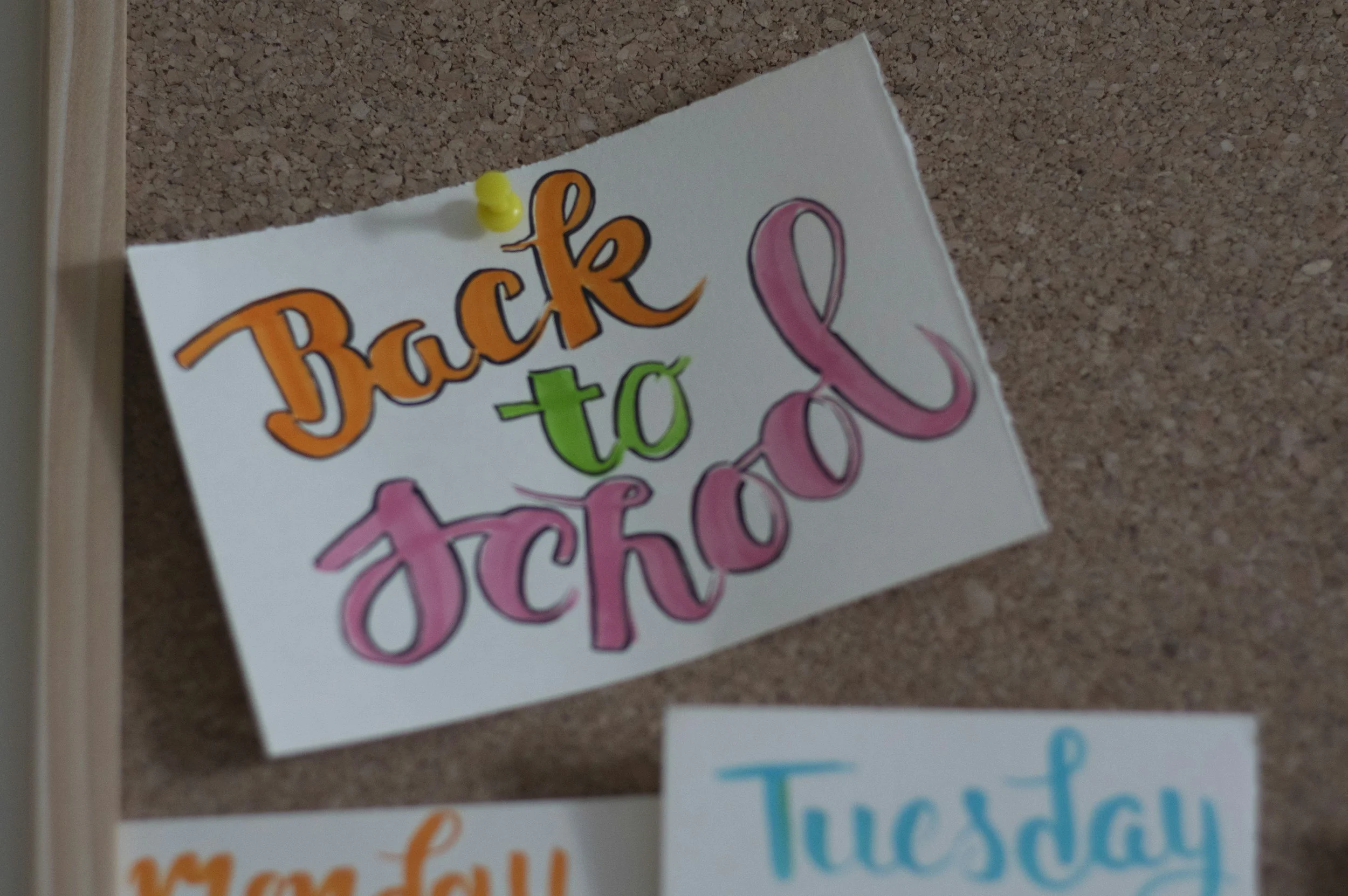
She said, expect a lot of big feelings over the next few days, maybe the next few weeks. And expect them to come out sideways. Over the wrong cup. Over a sock. Over something so small and so unrelated to anything that you will genuinely wonder if your child has been replaced. She told us not to go looking for the real reason, and not to try to talk them out of the fake one. She said hold the space, and let it come.
That was years ago. My kids are well past preschool now. And it is still the single most useful thing anyone has ever told me about school, because it turned out not to be preschool advice at all.
It is every year. It is every age. And it happens again after every long break.
What we are actually watching
Here is the part that gets misread, and it gets misread by good, attentive, well read parents constantly.
The after school meltdown looks like an emotional event. It arrives as one. Tears, or slammed doors, or a nine year old sobbing about a pencil.
But it is not, at its root, an emotional problem. It is a capacity problem that shows up emotionally.
Think about what a school day actually asks of a child, setting the academics aside entirely. Sit still when your body wants to move. Wait your turn when you already know the answer. Do not say the thing you are thinking. Stop the activity you are absorbed in because a bell rang. Start a new one immediately. Hold three instructions in your head at once. Read the room, continuously, to figure out where you stand socially today.
None of that is learning. All of that is regulating. And regulating runs on a finite daily budget.
By the time your child gets to you, the budget is gone. Not low. Gone. What you are seeing is not a child who has become unreasonable. It is a child operating with nothing left to operate with.
The re-learning nobody accounts for
Now add the thing the director actually named, which I have never once seen in the parenting coverage of this.
Every school year opens with an introductory period. Not just for kindergarteners. For everyone.
Your child is re-learning the environment. The building, or at least their new corner of it. The route to the bathroom. Where they sit. What the teacher's face means. Which of these kids they know and which are new and what happened to the friendships they left in June. What this particular teacher considers fine and what this particular teacher considers a problem, which is not the same as last year's teacher, and they will find out where that line is by accidentally crossing it.
And underneath all of it, the rules. School rules are not home rules. They are certainly not summer home rules, which by August have gone soft in all the places rules go soft when everyone is tired and it is hot and bedtime became a suggestion. On top of both sits a third layer, the social rules, the ones about how you are supposed to behave around other people in general, which children are still actively assembling.
So they are not just tired. They are running a full re-learning operation, all day, without complaining about it, because complaining about it is also against the rules.
That is why it happens in September and again in January and again after spring break. Every long, loose stretch of home time means the whole apparatus has to be rebuilt. Nothing was forgotten. The demand simply went from almost nothing to everything, overnight, and capacity does not scale that fast.
Why it lands on you
Here is the part that I think is genuinely worth sitting with, because it reframes the whole experience.
They did not fall apart at school. They fell apart at you.
That is not a failure of the day. That is the entire point of you.
A child holds it together in the environment where holding it together is required, and lets go in the environment where it is safe to let go. The letting go is not a breakdown of the system. It is the system working exactly as designed. You are the signal that the performance requirement has ended.
Stephen Porges' work on the early development of the autonomic nervous system describes this in physiological terms: safety cues from a trusted person allow the body to come out of a defensive, vigilant state and into a settled one (Porges & Furman, 2011). Your child has spent seven hours in low-grade vigilance, monitoring, scanning, bracing. They are not calming down from one bad moment. They are exiting a state they have been holding for the length of a workday.
The exit is loud. That is what an exit from that state sounds like.
One more thing, and this one is new
There is a reason this may be hitting harder than you remember it hitting, particularly if your child is somewhere between 10 and 13 years old.
A team at Georgetown's Context, Development & Social Policy Lab followed 667 children in the Tulsa public school district from preschool all the way through fifth grade, using data that started in 2018, before anyone had heard of any of this. That last part matters enormously. Most pandemic research has no real "before" to compare against. This one does.
Academically, the news is good. During the closures these kids lost close to three months of literacy growth and 14 months of math growth. But after schools reopened, their academic growth rate first slowed further, then climbed back to normal benchmarks within about two years. They recovered.
Executive functioning is the part that did not follow the same curve. During the closures they missed roughly a year of executive function growth, and this held even for the kids who participated in remote learning avidly. Effort did not protect them. Then, after schools reopened, they kept developing those skills at about 70% slower than the pre-pandemic pace (Wright et al., 2026).
Read that twice, because it is the whole thing. Two skills, two different recovery curves. The one everyone measured came back. The one nobody measures did not.
The children who were four to six before the pandemic are 10 to 13 now.
So the daily demand is the same as it has always been, and for a lot of kids the account it draws from is thinner than it would have been. Which means "he is too old for this" is very likely the wrong read on your particular child. The behavior is not regressed. The capacity is genuinely different, and it is not a character issue, and it is not something you caused.
I want to be careful here, because this is exactly the kind of finding that gets turned into a headline designed to frighten you, and the researcher herself went out of her way to say the opposite. Anna Wright, who led the work, put it this way: kids are really resilient, especially when given the right support, and it is easy to underestimate how resilient they are. She called it explicitly not an "all hope is lost" story.
I would go further. Knowing this makes the afternoons easier, not harder. If you have been reading your 10 year old's 3pm collapse as immaturity, or as something you failed to teach, this gives you a more accurate and considerably kinder explanation. And the supports Wright names are not remedial programs. They are organized environments, adults modeling regulation rather than demanding it, and responsive relationships. Every one of those is available in your kitchen.
One honest note on the research: this sample was low-income and racially diverse, deliberately, because that population gets left out of most studies like this one despite making up the majority of American public school students. Whether the exact numbers transfer to every district is a fair question. The pattern, two skills recovering at two different rates, is the part I would not bet against.
What to actually do, in the order it actually works
Most of the advice circulating right now stops at snacks and decompression time. That is not wrong. It is just where everyone stops, and the sequence matters more than the list.
Do not ask about their day at pickup. I know. Every instinct says ask. But retrieving what happened, putting it in order, choosing words for it and naming how it felt are all executive function tasks. You are billing an account that is already overdrawn. This is why the question produces "fine," or produces the explosion. The question is not the problem. The timing is.
Decompression is not screen time. This is the distinction I would most like parents to take from this piece, because it is the one that quietly costs families their evenings.
A screen does hold a child's attention. But it holds it involuntarily, without any effort from them, which is why it looks like rest. Restoration is a different process. In Attention Restoration Theory, recovering depleted directed attention requires an environment with gentle, undemanding interest, not one that captures attention and keeps it (Kaplan, 1995). A screen occupies the tank. It does not refill it.
So your child goes quiet, and you think it worked, and then bedtime is a disaster and nobody connects the two. It is not that screens are evil. It is that they are not doing the job you handed them.
Outside, if you can get there. Not as a nice idea. As the fastest available route out of that vigilant state. Natural environments produce a measurable physiological downshift, lower cortisol, slower heart rate, reduced muscle tension, and they restore the attention that indoor demand depletes (Kaplan, 1995; Ulrich et al., 1991). It does not need to be a forest. A yard, a walk, the least ambitious park you can reach. 20 unstructured minutes outdoors will do more than an hour of anything indoors, and nothing has to be said during it.
Then hold the space, and let it come. The pencil. The kid who cut in line. The rule that was not fair. The thing that happened at lunch that they have been carrying alone since 11:40 in the morning. It arrives out of order and out of proportion and attached to the wrong object. Do not fix it, and do not correct the object.
There is a real difference between absorbing and containing, and it matters. Absorbing means taking it all in and carrying it yourself, which is endless and eventually makes you resentful. Containing means being the walls of the thing while it happens, staying steady, not joining it. Containing is active, and it is finite. You can actually do it.
And then, after the downshift, ask something with no correct answer. Not how was your day. Try what was the loudest part of today. Or who made you laugh. Or what was the most annoying thing that happened. Low retrieval cost, no right answer, no evaluation. That is when you find out things.
How long
It might be a few days. It might be a few weeks. It dissipates as the environment stops being new, as they learn the classroom and the teacher and where the line is and who they eat lunch with now.
Until then, give them the space to release with grace.
You are their safe place. And that comes with moments that do not feel like a gift.
What Happens Next
If you are heading into the first weeks of school and you already know what this looks like in your house, the most useful thing you can do this week is protect the 90 minutes after pickup. No screens, outside if you can, no questions until the body has come down, and enough of your own bandwidth left to be steady when it arrives.
If it has been going on for longer than a few weeks, or the release is escalating instead of easing, or you are looking at your specific child and the general version of this does not quite fit, that is exactly what a discovery call is for. It is free, and it is built for mapping what is actually happening for your kid, at your kid's age, in your house, rather than handing you the general version again.
By Lauren Greeno
Child & Adolescent Development Specialist & Parenting Coach | Founder, The Parenting Collaborative
Lauren specializes in helping parents understand invisible dynamics shaping their children’s development and redesigning family systems before patterns calcify into adult identity. With expertise in child development, family systems theory, and trauma-informed parenting, she works with families navigating sibling dynamics, only child considerations, neurodivergence, emotional regulation, and breaking generational patterns.
Work with Lauren: Book a discovery call | Learn more| Instagram | TikTok
REFERENCES
Kaplan, S. (1995). The restorative benefits of nature: Toward an integrative framework. Journal of Environmental Psychology, 15, 169-182.
Porges, S. W., & Furman, S. A. (2011). The early development of the autonomic nervous system provides a neural platform for social behavior: A polyvagal perspective. Infant and Child Development, 20, 106-118.
Ulrich, R. S., Simons, R. F., Losito, B. D., Fiorito, E., Miles, M. A., & Zelson, M. (1991). Stress recovery during exposure to natural and urban environments. Journal of Environmental Psychology, 11, 201-230.
Wright, A., Martin, A., Pollak, S., Phillips, D., Stein, A., & Johnson, A. D. (2026). COVID-19-induced educational disruptions and children's executive functioning: A longitudinal cohort study. Developmental Psychology. https://doi.org/10.1037/dev0002113
