
If you’re wondering how to bond with your adopted baby, or with a baby born through surrogacy, start here: you can, and the research on how bonding works is on your side. Bonding isn’t something that only happens to the person who gave birth. It gets built, through closeness and responding, by whoever keeps showing up. What matters most is consistent care and, for children who had a hard start, how early that care began.
I’m Lauren Greeno, a child and adolescent development specialist, and attachment is the part of development I care about most. Below are the questions adoptive and surrogacy parents ask most, with straight answers first and the research after.
Can you bond with a baby you didn’t give birth to?
Yes. The biology of bonding follows what you do with your baby, not whether you were pregnant.
Oxytocin, the hormone most tied to bonding, gets described like it’s reserved for birth. In a study of 80 first-time parent couples, mothers’ and fathers’ oxytocin levels didn’t differ at about 6 weeks or at 6 months (Gordon et al., 2010). In a related study, oxytocin rose in the mothers who gave a lot of affectionate contact and the fathers who gave a lot of stimulating play (Feldman et al., 2010). And in a small study of 41 foster mothers, the ones whose oxytocin rose more after cuddling their foster child showed more delight when they played together (Bick et al., 2013).
These are small, correlational studies, so treat them as how the system seems to work rather than proof. But they point the same way: bonding is a loop of closeness and response that’s open to any parent.
How long does it take to bond with an adopted baby?
For any baby, adopted or not, a clear preference for specific people usually shows up in the second half of the first year (Schaffer & Emerson, 1964). So if your baby came home in the first days or weeks, you’re on the same timeline as every other family, because nobody gets that preference on day one.
The research on adopted babies backs this up. In a meta-analysis, children adopted before their first birthday were about as often securely attached as children who weren’t adopted. Those adopted after 12 months were less often secure, on average (van den Dries et al., 2009). That points to the timing and quality of care before placement, not adoption itself.
For older children, especially after institutional care or several placements, expect it to take longer. But that isn’t a sign it isn’t working.
Does skin-to-skin work if you didn’t give birth?
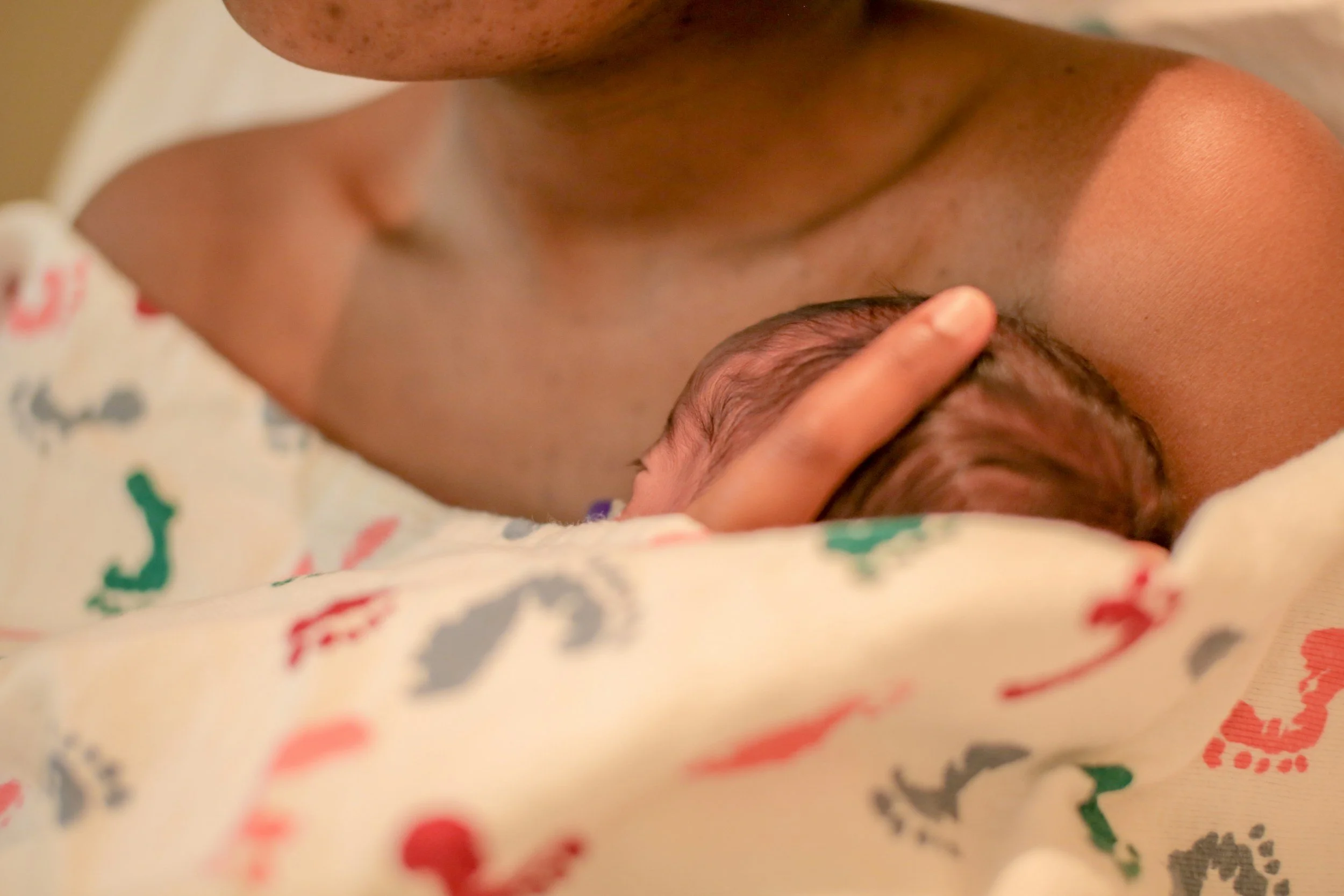
The best evidence we have says it helps. In a randomized trial with 83 first-time fathers, the dads who did at least 15 minutes of skin-to-skin a day for the first 3 days showed bigger gains in attachment than dads who didn’t (Chen et al., 2017). It was a short, single-site study, but the mechanism (warmth, closeness, responding) has nothing to do with who carried the baby.
From my work with families, not from a study: build it into ordinary routines like feeds, after the bath and before sleep, rather than saving it for a special moment.
What if we adopted an older child or a child from foster care?
Timing matters, and so does support. In the Bucharest Early Intervention Project, the only randomized trial of its kind, children moved from institutions into foster care before about age 2 were much more likely to be securely attached in the preschool years than children placed later (Smyke et al., 2010).
Some children who spent their early years in institutions show differences that can look confusing at home. In one brain-imaging study, typically raised kids’ amygdalas responded more to their mom’s face than to a stranger’s. Previously institutionalized kids responded about the same to both, and that went with more indiscriminate friendliness, the child who goes to any adult (Olsavsky et al., 2013). My read is that’s an adaptation to not having one reliable person early on, not a sign the child can’t attach.
The good news is that there are proven programs for exactly this:
• VIPP-SD (Video-feedback Intervention to promote Positive Parenting and Sensitive Discipline). In 130 families who adopted internationally, three video-feedback home visits made parents more sensitive and meant fewer babies had disorganized attachment at 12 months (Juffer et al., 2005). It’s now been tested in 25 randomized trials (van IJzendoorn et al., 2023).
• ABC (Attachment and Biobehavioral Catch-up). In a randomized trial with foster infants and toddlers, children whose caregivers did ABC had stress-hormone (cortisol) levels closer to children who had never been in foster care (Dozier et al., 2008).
Ask your agency, social worker or pediatrician about them by name.
Are adopted children more likely to have attachment or behavior problems?
On average, somewhat, but most adopted kids do well. In a meta-analysis of more than 25,000 adoptees, adopted kids had somewhat more behavior problems than non-adopted kids, but the differences were small, and most international adoptees were well adjusted (Juffer & van IJzendoorn, 2005). International adoptees who went through extreme adversity before adoption had more problems.
When should I tell my child they’re adopted?
Early, and more than once. In a survey of 254 adults who were adopted, those who learned at age 3 or later reported more distress and lower life satisfaction than those told earlier (Baden et al., 2019). It was a self-selected survey, so read it as a strong signal, not the final word.
What works with the families I see: tell the story in small, true pieces from the start, answer the question your child is actually asking, and keep the door open so they never have to work up the nerve to bring it up.
Why is my 7-year-old suddenly asking about adoption (or surrogacy)?
Because their brain grew. In a UK study following families from birth, children born through surrogacy showed somewhat more adjustment difficulties at age 7, still within the normal range, and the difference was gone by age 10 (Golombok et al., 2013). Research by David Brodzinsky suggests that in the early school years, as kids understand adoption more fully, many start to grasp that it also involves a loss.
In my experience, it’s the same story being re-read by a more capable brain. Revisit it with more detail around the early school years, before they have to come asking.
Quick answers
Does my baby know I’m not their birth mother? Research can’t tell us what a newborn “knows.” What it does show is that babies form their strongest attachments over the first year to the people who consistently care for them.
Is it normal not to feel an instant bond? Yes, for any parent. Bonding is built over months, through repetition, and it’s allowed to take time.
Can a baby have more than one attachment figure? Yes. Most babies attach to several caregivers (Schaffer & Emerson, 1964).
When should we get help? If your child came home after institutional care or several placements, or if you’re months in and it still feels like you can’t reach them, ask about VIPP-SD or ABC, or book a call.
Where to go from here
I’m speaking on exactly this at the free, virtual Famally Summit on Thursday, November 12: “Bonding Isn’t Born, It’s Built.”
And if you’re living this right now and want someone to talk more about bonding and attachment, that’s what a free discovery call is for.
By Lauren Greeno
Child & Adolescent Development Specialist & Parenting Coach | Founder, The Parenting Collaborative
Lauren specializes in helping parents understand invisible dynamics shaping their children’s development and redesigning family systems before patterns calcify into adult identity. With expertise in child development, family systems theory, and trauma-informed parenting, she works with families navigating sibling dynamics, only child considerations, neurodivergence, emotional regulation, and breaking generational patterns.
Work with Lauren: Book a discovery call | Learn more| Instagram | TikTok
References
Baden, A. L., Shadel, D., Morgan, R., White, E. E., Harrington, E. S., Christian, N., & Bates, T. A. (2019). Delaying adoption disclosure: A survey of late discovery adoptees. Journal of Family Issues, 40(9), 1154-1180. https://doi.org/10.1177/0192513X19829503
Bick, J., Dozier, M., Bernard, K., Grasso, D., & Simons, R. (2013). Foster mother-infant bonding: Associations between foster mothers’ oxytocin production, electrophysiological brain activity, feelings of commitment, and caregiving quality. Child Development, 84(3), 826-840. https://doi.org/10.1111/cdev.12008
Chen, E.-M., Gau, M.-L., Liu, C.-Y., & Lee, T.-Y. (2017). Effects of father-neonate skin-to-skin contact on attachment: A randomized controlled trial. Nursing Research and Practice, 2017, 8612024. https://doi.org/10.1155/2017/8612024
Dozier, M., Peloso, E., Lewis, E., Laurenceau, J.-P., & Levine, S. (2008). Effects of an attachment-based intervention on the cortisol production of infants and toddlers in foster care. Development and Psychopathology, 20(3), 845-859. https://doi.org/10.1017/S0954579408000400
Feldman, R., Gordon, I., Schneiderman, I., Weissman, O., & Zagoory-Sharon, O. (2010). Natural variations in maternal and paternal care are associated with systematic changes in oxytocin following parent-infant contact. Psychoneuroendocrinology, 35(8), 1133-1141.
Golombok, S., Blake, L., Casey, P., Roman, G., & Jadva, V. (2013). Children born through reproductive donation: A longitudinal study of psychological adjustment. Journal of Child Psychology and Psychiatry, 54(6), 653-660. https://doi.org/10.1111/jcpp.12015
Gordon, I., Zagoory-Sharon, O., Leckman, J. F., & Feldman, R. (2010). Oxytocin and the development of parenting in humans. Biological Psychiatry, 68(4), 377-382. https://doi.org/10.1016/j.biopsych.2010.02.005
Juffer, F., Bakermans-Kranenburg, M. J., & van IJzendoorn, M. H. (2005). The importance of parenting in the development of disorganized attachment: Evidence from a preventive intervention study in adoptive families. Journal of Child Psychology and Psychiatry, 46(3), 263-274.
Juffer, F., & van IJzendoorn, M. H. (2005). Behavior problems and mental health referrals of international adoptees: A meta-analysis. JAMA, 293(20), 2501-2515. https://doi.org/10.1001/jama.293.20.2501
Olsavsky, A. K., Telzer, E. H., Shapiro, M., Humphreys, K. L., Flannery, J., Goff, B., & Tottenham, N. (2013). Indiscriminate amygdala response to mothers and strangers after early maternal deprivation. Biological Psychiatry, 74(11), 853-860. https://doi.org/10.1016/j.biopsych.2013.05.025
Schaffer, H. R., & Emerson, P. E. (1964). The development of social attachments in infancy. Monographs of the Society for Research in Child Development, 29(3), 1-77.
Smyke, A. T., Zeanah, C. H., Fox, N. A., Nelson, C. A., & Guthrie, D. (2010). Placement in foster care enhances quality of attachment among young institutionalized children. Child Development, 81(1), 212-223.
van den Dries, L., Juffer, F., van IJzendoorn, M. H., & Bakermans-Kranenburg, M. J. (2009). Fostering security? A meta-analysis of attachment in adopted children. Children and Youth Services Review, 31(3), 410-421. https://doi.org/10.1016/j.childyouth.2008.09.008
van IJzendoorn, M. H., Schuengel, C., Wang, Q., & Bakermans-Kranenburg, M. J. (2023). Meta-analysis of the first 25 randomized controlled trials on the effects of VIPP-SD. Development and Psychopathology, 35(1), 241-256. https://doi.org/10.1017/S0954579421001462
