
What the Homeschooling Research Actually Says (And What It Can't Tell You)
A podcaster went viral this week for saying homeschooling is “weird,” and that he doesn't trust anyone who wants to be with their kids full time. The internet did what the internet does, it picked sides. I want to do something more useful by walking through what the actual research says, because almost nobody arguing about this right now has read it.
The academic picture is better than either side expects
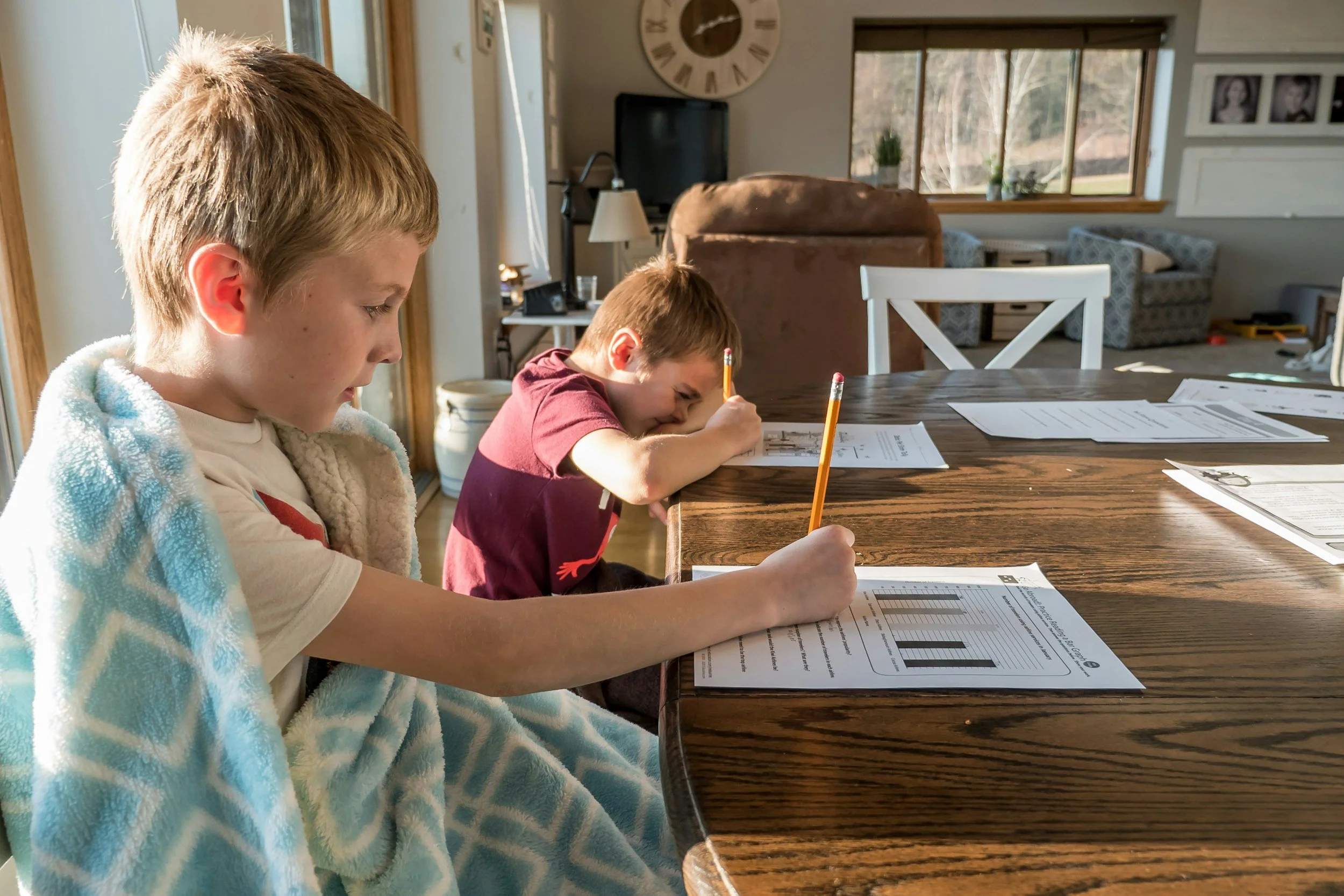
Across the body of peer-reviewed research, homeschooled students tend to score 15 to 25 percentile points above public school students on standardized achievement tests, landing in roughly the 75th to 79th percentile range across reading, language, math, social studies, and science (Ray, 2010; Ray, Hoelzle, & Pietersma, 2026). About 62% of peer-reviewed studies on academic achievement find homeschooled students performing significantly better than their institutionally schooled peers. That advantage holds up regardless of parents' education level or household income, and whether or not a parent was ever a certified teacher barely moves the needle.
Except in math, and the reason why matters
Here's the real exception, and it's the part most homeschooling advocates skip past. A well-designed Canadian study matched 37 homeschooled students with 37 public school peers and found that once you separate out structure, the story gets specific fast (Martin-Chang, Gould, & Meuse, 2011). Structured homeschoolers, kids taught from an organized curriculum, outperformed public school students across nearly every subject tested, often by a full grade level or more. Unstructured, child-led homeschoolers did not. They lagged, especially in math. The Coalition for Responsible Home Education, an organization that generally favors more homeschool oversight, has documented this same “math gap” in its own review of the data.
The likely reason isn't mysterious once you think about how the two subjects actually get practiced. Reading happens by accident all day long, road signs, texting, being read to, packaging at the grocery store. Nobody accidentally does long division at the pool. Math only improves through deliberate, structured practice, which means it's the one subject that's most exposed when a homeschool day lacks structure, and the one that responds fastest once structure gets added back in.
This is worth connecting to how homeschooling actually gets talked about in your feed, because the loudest voices aren't describing the structured version. When Kourtney Kardashian said on Khloé's podcast last year that school felt "so dated" and that she was open to homeschooling because her kids kept sending her videos of successful people who skipped it, what she described, drifting into homeschooling because your kids are persuasive, is the unstructured, child-led variant. That's the one place the research shows kids falling behind. The point isn't to pick on one family's choice. It's that the version of homeschooling being modeled by the most-followed mothers in America is the exact version the data flags, and almost nobody sharing those clips knows there's a difference.
Socialization tilts the other direction, and the mechanism is worth understanding
This is the part that would probably surprise the podcaster. About 64% of studies on social and emotional development find homeschooled kids doing statistically better, not worse, than conventionally schooled peers (Ray, Hoelzle, & Pietersma, 2026). Richard Medlin, the psychologist most cited in this specific area, has reviewed this literature twice, in 2000 and again in 2013, and both times reached the same conclusion: homeschooled children tend to report higher-quality friendships, stronger relationships with parents and other adults, and moral reasoning at least as advanced as their peers (Medlin, 2000, 2013).
Part of the likely mechanism is exposure. Homeschooling parents in these studies deliberately built social opportunities into the week rather than assuming they'd happen by default, co-ops, sports, mixed-age activities, community involvement. Part of it may also be structural. Homeschooled kids often spend real time across a wider age range instead of being sorted into a single-grade cohort for eight hours a day, which some researchers argue is a more natural social environment than the one most of us grew up assuming was standard.
The honest caveat, and the actual point of this piece
None of this research proves homeschooling causes these outcomes. Almost all of it draws from self-selected, highly engaged homeschooling families and self-reported data, not neutral outside assessment. The far more defensible read is that the kind of parent who chooses and sustains homeschooling is already an unusually involved, resourced parent, and that involvement is likely doing most of the work in these numbers, not the schooling model by itself.
Which means the podcaster and the parents defending homeschooling are both making the same mistake: treating a schooling choice as the variable that explains a kid's outcome, when the research keeps pointing somewhere else, at the relationship and the structure underneath it. That's true whether your kid is homeschooled, public schooled, or something in between.
If you're trying to figure out what your specific kid actually needs, more structure, more connection, some mix of both, that's exactly what a discovery call is for. It's 30 minutes, and we map your kid's specific schooling and social emotional needs together, not a generic homeschool-or-not debate. Book one below.
By Lauren Greeno
Child & Adolescent Development Specialist & Parenting Coach | Founder, The Parenting Collaborative
Lauren specializes in helping parents understand invisible dynamics shaping their children’s development and redesigning family systems before patterns calcify into adult identity. With expertise in child development, family systems theory, and trauma-informed parenting, she works with families navigating sibling dynamics, only child considerations, neurodivergence, emotional regulation, and breaking generational patterns.
References:
Coalition for Responsible Home Education. (n.d.). The homeschool math gap: The data.
Martin-Chang, S., Gould, O. N., & Meuse, R. E. (2011). The impact of schooling on academic achievement: Evidence from homeschooled and traditionally schooled students. Canadian Journal of Behavioural Science, 43(3), 195–202. https://doi.org/10.1037/a0022697
Medlin, R. G. (2000). Home schooling and the question of socialization. Peabody Journal of Education, 75(1–2), 107–123.
Medlin, R. G. (2013). Homeschooling and the question of socialization revisited. Peabody Journal of Education, 88(3), 284–297.
Ray, B. D. (2010). Academic achievement and demographic traits of homeschool students: A nationwide study. Academic Leadership: The Online Journal, 8(1).
Ray, B. D., Hoelzle, R., & Pietersma, R. (2026). Homeschool academic achievement fact sheet. National Home Education Research Institute.
