
Why Having Fun Is a Parenting Strategy, Not a Luxury
I did a cartwheel on the beach recently. Completely unplanned. My son was there. The sun was out. And for about three seconds, I forgot that I was a grown adult with a business and a mortgage and two kids and seventeen things on my to-do list.
I am a child development specialist. I study this, teach it, and built a practice around it. Which made it a little humbling to realize I needed an accidental cartwheel on a Tuesday afternoon to feel like a person who was allowed to enjoy something unplanned.
This is not a knowledge problem. That is what I want to talk about first. Because if you are reading this, you probably already know the right things. What tends to get quietly abandoned is not the information. It is the actual inhabiting of the life being built. And child development research has something specific to say about what that costs.
What High-Achieving Parents Stop Doing
Most of the parents I work with are genuinely excellent at building a life. The career is working. The kids are in the right programs. The household runs. They are doing all of the things.
And a lot of them have quietly stopped enjoying any of it.

This is not a character flaw. It is a pattern. The Type A parent who finds identity in competence, who treats responsibility like a badge of honor, who is extraordinarily capable under pressure and extraordinarily uncomfortable just being. There is a specific kind of exhaustion that comes not from doing too much but from never being fully present inside what you are doing. From managing life instead of inhabiting it.
What most parenting content will not tell you: that exhaustion does not stay with you. It travels.
What Child Development Research Says About Parental Joy
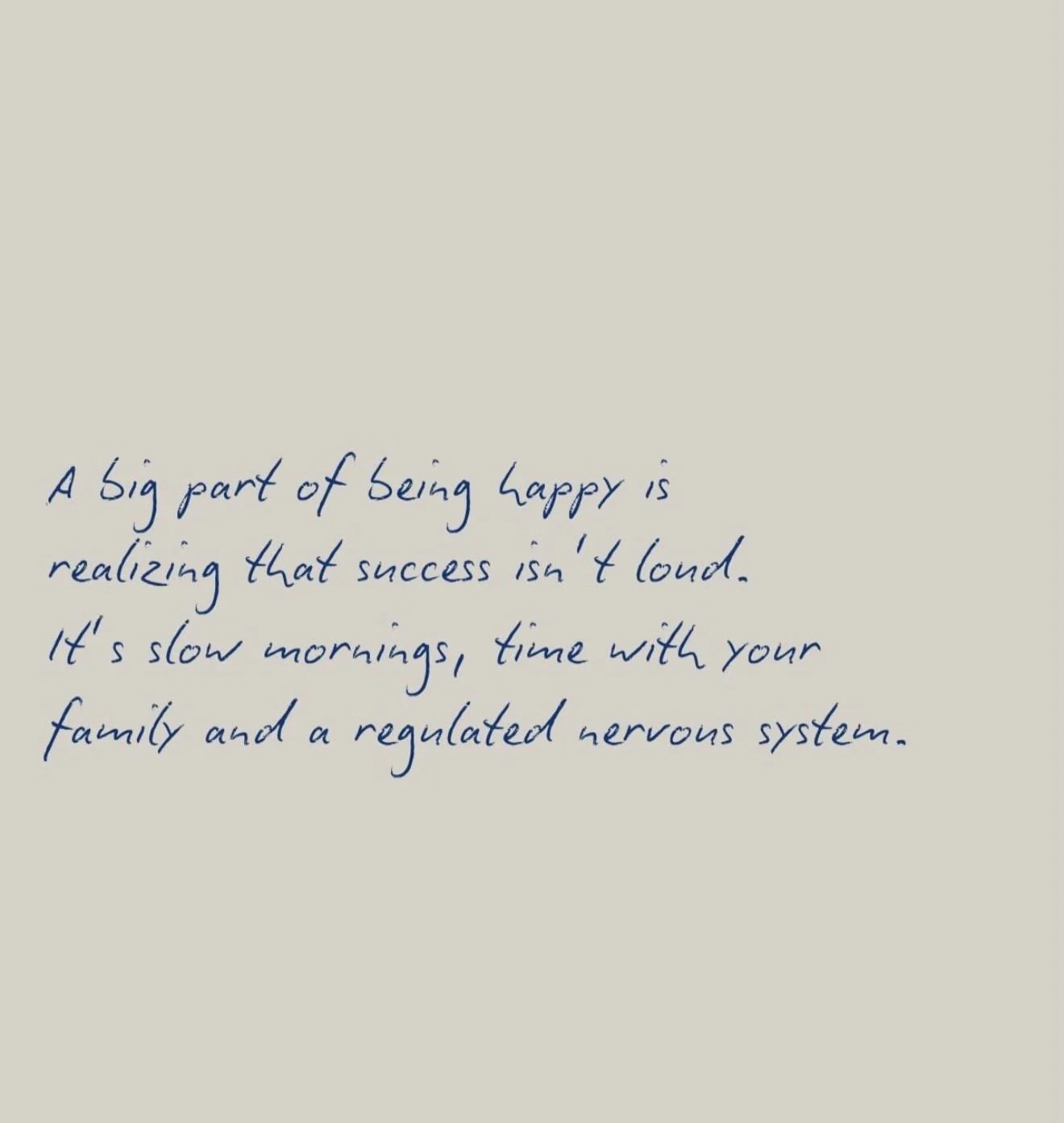
Albert Bandura's Social Learning Theory (1977) makes something clear that parents often underestimate: children learn their most foundational behaviors not from instruction, but from observation. You are the primary curriculum. Not the books you read to them, not the values you articulate at the dinner table. The daily emotional posture you inhabit, how you move through the world, whether you appear to be a person who enjoys being alive, that is what gets internalized.
A parent who models chronic stress and joyless productivity is teaching that. Not intentionally. Not because she is a bad parent. Because the research is consistent: children absorb the emotional state of their primary caregiver more than they absorb almost anything else (Bandura, 1977).
Your Child Is Borrowing Your Nervous System
Here is the developmental mechanism that makes this more than a philosophical point.
Children's nervous systems are not self-regulating until the prefrontal cortex fully matures. This does not happen until the mid-20s. Until then, children borrow emotional regulation capacity from the adults around them. Daniel Siegel calls this co-regulation: the process by which a child's dysregulated nervous system can down-regulate in the presence of a calm, present adult (Siegel & Bryson, 2011).
This means a parent who is physically present but mentally elsewhere, running the to-do list, managing the next problem, is still providing a dysregulated signal, even in silence.

A parent who is genuinely present, genuinely regulated, and genuinely enjoying the moment is providing a nervous system resource her child cannot yet generate independently.
Your joy is not self-indulgent. It is a resource your child is actively borrowing.
The Perfectionism-Burnout Connection
Perfectionism feels protective. If I anticipate every problem, manage every variable, get everything handled, nothing will go wrong and my kids will be okay.
The research disagrees.
Mikolajczak and Roskam (2018), whose work on parental burnout has reshaped how researchers understand high-functioning parenting failure, found that perfectionism is one of the strongest predictors of burnout. And burned-out parents show measurable increases in neglect behaviors and decreases in attunement, the very outcome perfectionist parents were working to prevent.
Winnicott (1960) called this six decades ago with the concept of the "good enough" parent: not perfect, not optimal, but present, responsive, and capable of repair after rupture. That is what secure attachment requires. Perfection is not only unnecessary. It is beside the point.
What Adult Play Research Says
Stuart Brown's decades of research on play are consistent: adults need genuine, unstructured, childlike play just as much as children do. Play deprivation in adults is linked to depression, emotional rigidity, and decreased capacity for empathy and connection (Brown & Vaughan, 2009). The opposite of play is not responsibility. It is depression.
When a parent plays, she is not neglecting her children. She is modeling what it looks like to be a human being who enjoys being alive. That is one of the most protective things a child can witness.

The Generational Thread
I got into child development because I wanted to understand my own kids in ways they could not yet articulate. What I have noticed, turning that same lens on myself, is a pattern Bowlby described decades ago: the emotional postures we absorbed from our own parents become our default templates until we consciously examine and revise them (Bowlby, 1969). Parents who can hold their own history with some coherence, even when it was complicated, can parent their children securely regardless of what their own childhood looked like.
The reflection is the intervention.
What This Means In Practice
None of this requires a vacation, a complete identity overhaul, or becoming a different version of yourself by next Monday. It requires what Winnicott suggested six decades ago, and what the more recent research confirms: presence, not perfection. As a mother myself, I am never going to suggest something to you that I didn’t think you could accomplish while you are parenting, managing life, careers, households, and possibly reparenting yourself in real time too.
A parent who is regulated, genuinely engaged with her own life, and modeling enjoyment of the moment she is actually in is providing something measurably significant to her child's development. Not because she has earned it. Because her child is actively borrowing it.
The cartwheel on the beach was three seconds. That was enough. Sometimes I need to sit in the sun for 10 minutes. What happiness is for you is individual to you. What is fun for you doesn’t need to be this big thing. That is what slowed me down. And what I realized just this week is sitting in the sun brings a smile to my face. Learning about myself and my kids is fun for me. It can be that simple. It can be that small.
If the everyday triggers are what is getting in the way first, the moments when something small sets you off and there is no cartwheel available, that is what the Presence Protocol is for. It is what I use when everyday life is triggering me. It is what I teach my own kids. It is what I give every client. A four-step nervous system tool for the moments when you need to be present and you are not there yet.
If you want to understand your specific child the way I am learning to understand myself and my own kiddos, the way my clients are working to learn and support theirs, a discovery call is where we start.
A developmental read looks at your child's temperament, cognitive style, emotional wiring, behavioral patterns, and physiological responses. Not a category. Your actual child. You leave knowing why they do what they do, why the standard advice keeps not fitting them, and what to shift first.
By Lauren Greeno
Child & Adolescent Development Specialist & Parenting Coach | Founder, The Parenting Collaborative
Lauren specializes in helping parents understand invisible dynamics shaping their children’s development and redesigning family systems before patterns calcify into adult identity. With expertise in child development, family systems theory, and trauma-informed parenting, she works with families navigating sibling dynamics, only child considerations, neurodivergence, emotional regulation, and breaking generational patterns.
Work with Lauren: Book a discovery call | Learn more| Instagram | TikTok
References:
Bandura, A. (1977). Social learning theory. Prentice Hall.
Bowlby, J. (1969). Attachment and loss: Vol. 1. Attachment. Basic Books.
Brown, S., & Vaughan, C. (2009). Play: How it shapes the brain, opens the imagination, and invigorates the soul. Avery.
Mikolajczak, M., & Roskam, I. (2018). A theoretical and clinical framework for parental burnout: The Balance Between Risks and Resources (BR2). Frontiers in Psychology, 9, 886. https://doi.org/10.3389/fpsyg.2018.00886
Siegel, D. J., & Bryson, T. P. (2011). The whole-brain child: 12 revolutionary strategies to nurture your child's developing mind. Delacorte Press.
Winnicott, D. W. (1960). The theory of the parent-infant relationship. International Journal of Psycho-Analysis, 41, 585-595.
